Annelids are considered members of the Lophotrochozoa, a "super-phylum" of protostomes that also includes molluscs, brachiopods, and nemerteans. The basic annelid form consists of multiple segments called metameres. Each segment has the same sets of organs and, in most polychaetes, has a pair of parapodia that many species use for locomotion.
Annelid, any member of a phylum of invertebrate animals that are characterized by the possession of a body cavity (or coelom), movable bristles (or setae), and a body divided into segments by transverse rings, or annulations, from which they take their name. The coelom is reduced in leeches, and
Study with Quizlet and memorize flashcards containing terms like Phylum Annelida, Annelids are broken into two groups, the ______ and _______. The first group does not constitute clade and is _______., 5 characteristics of polychaetes and more.
An annelid’s body is segmented into a linear series of rings called annuli. Each segment contains the same set of organs (metamerism), though they share a common gut, as well as nervous and circulatory systems.
Mollusks display a wide range of morphologies in each class and subclass, but share a few key characteristics (Figure 28.21). The chief locomotor structure is usually a muscular foot. Most internal organs are contained in a region called the visceral mass.
Parasitism of polychaetes might be explained by co-evolution from an ancestor common to the Mollusca and Annelida, but the extent to which the parasite lines remain similar in the face of the difference between annelids and molluscs makes this possibility remote.
The annelids and the mollusks are the most familiar of the lophotrochozoan protostomes. They are also more “typical” lophotrochozoans, since both groups include aquatic species with trochophore larvae, which unite both taxa in common ancestry. These phyla show how a flexible body plan can lead to biological success in terms of abundance and species diversity. The phylum Mollusca has the
The Polychaeta /ˌ P ɒlɪˈ K iː T ə/ or polychaetes are a paraphyletic class of annelid WoRMS, generally marine. Each body segment has a pair of fleshy protrusions called parapodia that bear many bristles, called chaetae, which are made of chitin. As such, polychaetes are sometimes referred to as bristle worms.
Molluscs include such familiar creatures as clams, oysters, snails, and octopi. They share a distant common ancestor with the annelid worms, an evolutionary heritage suggested by their larval form, called a trochophore larva, found in all molluscs and in certain marine annelids called polychaete worms.
The phylum Mollusca has the second greatest number of species of all animal phyla with nearly 100,000 described extant species, and about 80,000 described extinct species. In fact, it is estimated that about 25 percent of all known marine species are mollusks!
The mollusks are a diverse group (85,000 described species) of mostly marine species. They have a variety of forms, ranging from large predatory squid and octopus, some of which show a high degree of intelligence, to small grazing forms with elaborately sculpted and colored shells. The annelids traditionally include the oligochaetes, which include the earthworms and leeches, the polychaetes
The annelids traditionally include the oligochaetes, which include the earthworms and leeches, the polychaetes, which are a marine group, and two other smaller classes. The phyla Mollusca and Annelida belong to a clade called the Lophotrochozoa, which also includes the phylum Nemertea, or ribbon worms ( [link]).
The annelids traditionally include the oligochaetes, which include the earthworms and leeches, the polychaetes, which are a marine group, and two other smaller classes. The phyla Mollusca and Annelida belong to a clade called the Lophotrochozoa, which also includes the phylum Nemertea, or ribbon worms ( [link]).
The mollusks are a diverse group (85,000 described species) of mostly marine species. They have a variety of forms, ranging from large predatory squid and octopus, some of which show a high degree of intelligence, to small grazing forms with elaborately sculpted and colored shells. The annelids traditionally include the oligochaetes, which include the earthworms and leeches, the polychaetes
The annelids traditionally include the oligochaetes, which include the earthworms and leeches, the polychaetes, which are a marine group, and two other smaller classes. The phyla Mollusca and Annelida belong to a clade called the Lophotrochozoa, which also includes the phylum Nemertea, or ribbon worms ( [link]).
The mollusks are a diverse group (85,000 described species) of mostly marine species. They have a variety of forms, ranging from large predatory squid and octopus, some of which show a high degree of intelligence, to small grazing forms with elaborately sculpted and colored shells. The annelids traditionally include the oligochaetes, which include the earthworms and leeches, the polychaetes
The phylum Mollusca has the second greatest number of species of all animal phyla with nearly 100,000 described extant species, and about 80,000 described extinct species. In fact, it is estimated that about 25 percent of all known marine species are mollusks!
The annelids traditionally include the oligochaetes, which include the earthworms and leeches, the polychaetes, which are a marine group, and two other smaller classes. The phyla Mollusca and Annelida belong to a clade called the Lophotrochozoa, which also includes the phylum Nemertea, or ribbon worms.
bryozoans phornids slugs An annelid characteristic of polychaetes shared by all mollusks is a trochophore larva a closed circulatory system segmentation the number of heart chambers
Molluscs display a wide range of morphologies in each class and subclass, but share a few key characteristics (Figure 15.34). The chief locomotor structure is usually a muscular foot. Most internal organs are contained in a region called the visceral mass.
The basic annelid form consists of multiple segments called metameres. Each segment has the same sets of organs and, in most polychaetes, has a pair of parapodia that many species use for locomotion. Septa separate the segments of many species, but are poorly defined or absent in others, and Echiura and Sipuncula show no obvious signs of segmentation.
Polychaetes are a class of annelids known for their distinct bristle-like structures called chaetae, or setae, which are located on each body segment. They are primarily marine organisms and exhibit a wide range of body forms and lifestyles.
Polychaetes have setae but do not utilize setae for locomotion. Sedentary worms may use hooked setae to anchor in their tubes. In some worms, the setae are defensive, penetrating the body of the attacker, breaking off, and causing irritation. We will use the earthworm as our model animal, an Oligochaete (old phylum), belonging to the class or clade Clitellata, or Annelids with a clitellum, a swelling towards the head of the animal.
An annelid characteristic of polychaetes shared by all mollusks is · A) a trochophore larva · B) a closed circulatory system · C) segmentation · D) the number of heart chambers · E) a marine habitat · 24 · Ectoprocts attach to rocks by means of · A) cirri · B) tentacles ·
The annelids are often called “segmented worms” due to their key characteristic of metamerism, or true segmentation. Approximately 16,500 species have been described in phylum Annelida, which includes polychaete worms (marine annelids with multiple appendages), and oligochaetes (earthworms
The annelids are often called “segmented worms” due to their key characteristic of metamerism, or true segmentation. Approximately 16,500 species have been described in phylum Annelida, which includes polychaete worms (marine annelids with
The annelids are often called “segmented worms” due to their key characteristic of metamerism, or true segmentation. Approximately 16,500 species have been described in phylum Annelida, which includes polychaete worms (marine annelids with
We cannot provide a description for this page right now
Segmentation is both external and internal, which is called metamerism. Annelids are protostomes. The presence of chitinous hairs called chaetae is characteristic of most members. These animals have well-developed nervous and digestive systems.
It is solidly placed within the Annelida by modern taxonomists. This clade of worms usually possesses well-developed parapodia and two pairs of multicellular eyes. They comprise a portion of the old class grouping, Polychaeta.
Chitinous hairlike extensions, anchored in the skin and projecting from the cuticle, called chaetae, are present in every segment in most groups. The chaetae are a defining character of annelids. Polychaete worms have paired, unjointed limbs
Chitinous hairlike extensions, anchored in the skin and projecting from the cuticle, called chaetae, are present in every segment in most groups. The chaetae are a defining character of annelids. Polychaete worms have paired, unjointed limbs
Polychaetes do not utilize setae for locomotion, but sedentary worms may use hooked setae to anchor in their tubes. In some worms, the setae are defensive, penetrating the body of the attacker, breaking off, and causing irritation. Differences in structure in the clades. 1. We will use in lab the the earthworm as our model animal, an Oligochaete (old phylum), belonging to the class or clade Clitellata, or Annelids with a clitellum, a swelling towards the head of the animal.
Chitinous hairlike extensions, anchored in the skin and projecting from the cuticle, called chaetae, are present in every segment in most groups. The chaetae are a defining character of annelids. Polychaete worms have paired, unjointed limbs
Segmentation is both external and internal, which is called metamerism. Annelids are protostomes. The presence of chitinous hairs called chaetae is characteristic of most members. These animals have well-developed nervous and digestive systems.
Annelid, any member of a phylum of invertebrate animals that are characterized by the possession of a body cavity (or coelom), movable bristles (or setae), and a body divided into segments by transverse rings, or annulations, from which they
The annelids are often called “segmented worms” due to their key characteristic of metamerism, or true segmentation. Approximately 16,500 species have been described in phylum Annelida, which includes polychaete worms (marine annelids with
Molluscs include such familiar creatures as clams, oysters, snails, and octopi. They share a distant common ancestor with the annelid worms, an evolutionary heritage suggested by their larval form, called a trochophore larva, found in all molluscs and in certain marine annelids called polychaete
Segmentation is both external and internal, which is called metamerism. Annelids are protostomes. The presence of chitinous hairs called chaetae is characteristic of most members. These animals have well-developed nervous and digestive systems. Polychaete annelids have parapodia that participate
Segmentation is both external and internal, which is called metamerism. Annelids are protostomes. The presence of chitinous hairs called chaetae is characteristic of most members. These animals have well-developed nervous and digestive systems.
an annelid characteristic of polychaetes shared by all mollusks is
Annual rate of tree fellling in Brazil’s tropical wilds has almost doubled since conservative became president
The large-scale deforestation of the Amazon rainforest in Brazil has intensified under the leadership of outspoken right-wing populist leader Jair Bolsonaro, a new research paper has found.
Mr Bolsonaro used his appearance at his US counterpart Joe Biden’s White House climate summit last week to pledge an end to illegal logging in the Amazon by 2030, placing the blame for the global environmental crisis on developed nations whom he attacked for “burning fossil fuels in the course of the past two centuries”.
But his administration also failed to come to an agreement with the US on a deal to safeguard the country’s valuable rainforests, despite optimism that an accord could be forged prior to the gathering of 40 heads of state for Earth Day 2021.
The international spotlight falling on Mr Bolsonaro’s intentions towards the environment coincided with the publication of a damning new report by forestry engineer Ralph Trancoso of the University of Queensland in Australia in the academic journal Environmental Research Letters.
In “Changing Amazon Deforestation Patterns”, Mr Trancoso writes that, in the decade prior to Mr Bolsonaro’s election in 2019, the annual deforestation rate of the Amazon was 2,507 square miles.
 Climate crisis: UK, US and Norway unite for $1bn rainforest protection initiative
 ‘He’s causing terrible suffering’: Bolsonaro’s ‘death bill’ will devastate the rainforest and its peoples
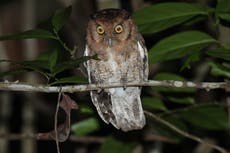 Two new species of ‘critically endangered’ owl discovered in Amazon rainforest
 Two-thirds of world’s original tropical rainforest cover degraded or destroyed by people, report finds
Now 4,281 square miles are now being cleared every year, he reports, citing data from Brazil’s National Institute for Space Research, which has been monitoring Amazon deforestation since 1971.
Mr Trancoso puts the stark increase down to illegal loggers feeling emboldened to act by the new president’s indifference to the climate crisis and conservation.
“Imagine the annual deforestation rate as a cake which can be cut in a variety of ways depending on how hungry the guests are - or in this case, the loggers. Today, the cake is being cut into much larger chunks because the criminals are hungrier, driven by current environmental policies,” Mr Trancoso told Mongabay.
“The average size of deforested areas has increased 61 per cent under the Bolsonaro administration as compared to the previous decade [2009-2018] when policies were, to a certain extent, implemented.
“The current interest is to cut down a lot of trees,” he added. “Before, deforesters knew they could be caught, but now their posture seems to have changed. They are no longer afraid of governmental monitoring or controls. On the contrary: they feel driven to take down more forest because they know they won’t be penalised.”
Mr Trancoso has previously worked for the Brazilian government and advocates for policies like the Action Plan for the Prevention and Control of Deforestation in the Legal Amazon, which cut the annual rate of deforestation by 83 per cent between 2004 and 2013, before being cut by the country’s environment ministry in 2013 and abandoned entirely by Mr Bolsonaro last year.
Brazil’s environmental protection agencies suffered further cutbacks in 2020 as the coronavirus pandemic took hold and became a political priority.
But the engineer argues that the country does have the expertise to restrict the resurgence in illegal logging and said the crucial starting point is to identity whether small-scale family farmers or bigger organisations are involved.
“Nobody cuts down 100 hectares with a chainsaw. It involves giant machines, without a doubt,” he said. “If we know the type [of deforester at work], it’s easier to control and define policies to combat it.”

While many countries saw a reduction in their greenhouse gas emissions last year as their economies ground to a halt because of national lockdowns, Brazil’s actually increased by 20 per cent because of increased deforestation and cattle ranching, the Brazilian advocacy group the Climate Observatory has said.
On the devastation done to the Amazon rainforest, which plays a vital role in regulating global climate, Mr Trancoso said: “The larger the destroyed area, the harder it is for it to regenerate. Animals no longer live there and the seed stock of the soil is exhausted. Natural regeneration becomes seriously compromised.”
Mr Trancoso argued that economic pressure from the international community, like agreements not to buy beef or soybean exports cultivated on deforested land, is crucial to ensuring the Bolsonaro administration plays ball on the environment.
“Brazil has to feel the pressure from the economic side. Just environmental issues aren’t enough for the current administration,” he said.
“Broad patches of deforestation are easier to see on satellite images and also facilitate concentrating forces in the field to apply fiscal controls. Initiatives that worked in the past must be taken up again.”
Join our commenting forum
Join thought-provoking conversations, follow other Independent readers and see their replies
Comments
Bookmark popover
Removed from bookmarks